10 August 2026 · 4 min read
A Promenade on the Aventino
One of the seven hills, and the quietest of them — an itinerary through orange trees, a fifth-century basilica, a rose garden and the most famous keyhole in the world.
Every visitor knows the Palatine and the Capitoline. Almost nobody climbs the Aventino, which is strange, because it offers the best short walk in Rome: an hour and a half, almost no traffic, and views that the crowded terraces across the river cannot match. It is my standard prescription for a first jet-lagged morning or a Sunday with nowhere to be.
The hill that lost the bet
The Aventine is one of the canonical seven hills of Rome, and in the founding legend it is the losing one: Romulus watched for his augural birds from the Palatine, Remus from the Aventine, and we know how the argument ended. In the Republic the hill stayed outside the sacred boundary of the city — it was the plebeian hill, the hill of merchants and outsiders, home to the great temple of Diana. When the plebeians went on strike against the patricians, this is where they withdrew: the Aventine Secession, a name Italian politics recycled as recently as 1924, when opposition deputies walked out of Parliament after the murder of Giacomo Matteotti. For a quiet hill, it has a long history of dissent. Today the dissent is over: the Aventino is leafy, residential and almost silent — umbrella pines, garden walls, and some of the most enviable addresses in the city.
The promenade
Start at the bottom, on the Tiber side of the Circo Massimo, and climb the Clivo dei Publicii. First stop, on your right in May and June especially: the Roseto Comunale, Rome’s municipal rose garden, laid out on the slope with the Palatine as its backdrop. It only opens when the roses bloom, roughly spring to early summer — if the gate is open, go in; it is free, and it smells like the month of May.
A little higher sits the Giardino degli Aranci — officially Parco Savello, universally the Orange Garden. A walled garden of bitter orange trees ending in a terrace that hangs over the river, with the whole city laid out to the dome of St Peter’s. Sunset here is popular but never Trastevere-crowded. The oranges, by the way, are decorative and ferociously sour; watching a tourist try one is a local sport.
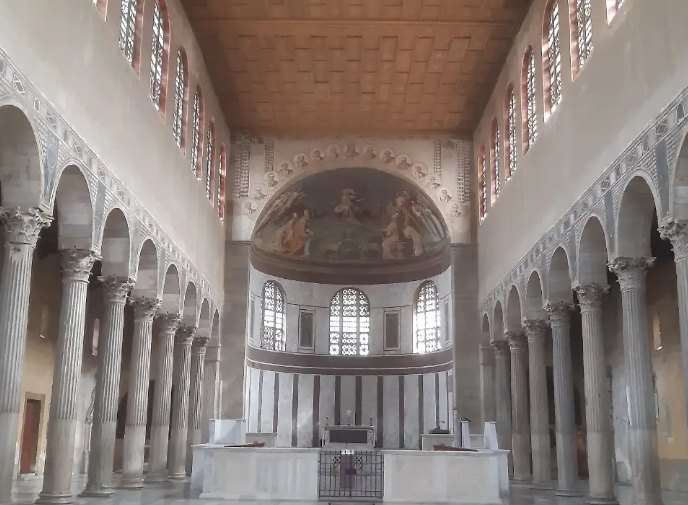
Next door is the reason I would climb the hill even without the gardens: Santa Sabina, the most beautiful early Christian basilica in Rome, essentially unchanged since the 430s. Light through selenite windows, a perfect colonnade, and — do not miss them — the original cypress-wood doors, carved with one of the oldest surviving images of the Crucifixion anywhere.
Finish at Piazza dei Cavalieri di Malta, the theatrical little square designed by Piranesi — the only thing he ever built. In the green gate of the Priory of the Knights of Malta is the famous keyhole: put your eye to it, they say, and the dome of St Peter’s appears at the end of a tunnel of clipped hedges, three sovereign territories lined up in one view. I have to confess I have never looked. There is always a line, and a crowd taking turns at a keyhole on the quietest hill in Rome is a little disturbing — it has the bitter taste of overtourism. I would rather look at the square itself, and then walk back down to the orange terrace.